

 Introductory Note:
This version of Cansema® was made only in the smaller 22 g. jar.
Please read below for particulars. |
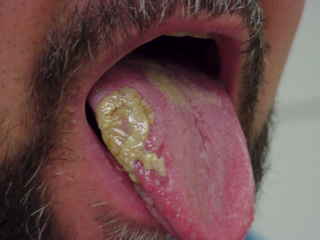
 n addition to its topical use,
Cansema® has -- for years -- been used inside the
oral cavity. Our first sizeable pictorial on the subject was posted in 2000 and involved
the case of Kent Estes
(1999-2000).Kent's story
is told on this site.

 On one of my first forays into
the Amazon -- well into Pastaza, near Achuar territory, I happened
to learn about a tree called "Nuwais" (its name in the Shuar language --
the exact scientific name is in dispute because of variations,
a matter in which we are
working to resolve with academic botanists here in Ecuador).I happened to ask why villagers
would chew on the inner bark of the tree, whose transverse cross-section is one of the
most beautiful, mysterious patterns I have ever seen. (Beneath
the periderm, the xylem and phloem commingle to form
a perfect cross, as can be seen in the photo above.)The answer I received was
most unexpected: the tree bark is traditionally used to clean the teeth.
Soon thereafter I began using the herb myself in the same
fashion as my villager-friends and the thought arose to create
a variation of Cansema® that was more closely tailored
to oral use than the original Cansema® formula.Over the ensuing months,
we experienced with Nuwais in a variety of formats: decoctions,
infusions . . . in both olive oil and water . . . and found that
Nuwais worked best when used made into a concentrated tea that
acted as the reconstituting agent in the manufacture of
a "Nuwais-based" Cansema®.Out of that effort and
experimentation comes Cansema® Nuwais.INGREDIENTS: Zinc chloride,
chapparal (Larrea mexicata or divaricata), glycerine, nuwais extract
(nuwais, distilled water).
If you have any questions
about this product, please email us with your
queries or concerns.
Which Cansema®
Should I Choose?
Should I Choose?
We realize that this is
the fifth Cansema version to be introduced, since we began
selling escharotic preparations to the public in 1990.That some users -- and
perhaps even practitioners -- may be confused by the choices, is understandable.
Below we provide here a quick summation, in brief, of the versions
now available, their functions and differences, and links to more detailed product pages: ( 1 ) Cansema® Black Topical
Salve (Original) --
This is the original Cansema® formula -- with trademarks prior to
1995 including HerbVeil 8 and Formula G.( 2 ) Cansema® Salve Deep Tissue --
A variation formulated with enhanced transdermal properties.( 3 ) Cansema® With Iodine --
This variation contains added Lugol's iodine.( 4 ) Cansema® Salve for Cats, Dogs & Horses --
This is a variation for veterinary use. It is a variation of "Deep Tissue."( 5 ) Cansema® Salve with Nuwais --
This variation was also introduced in Sept. 2009.( 6 ) Cansema® Salve with Aloe Vera Gel --
And, finally, this variation -- a less aggressive formula that extends the timeline of the process.A complete list of ingredients, along with more detailed information, can be found in the
answer to Question #200 in the Cansema FAQ section.