

Composition
 General Info
Research Papers
Agaricus Extract - 120 Caps x 700 mg.
Agaricus Drops (4:1 Extract) - 4 fl. oz.
Availability
General Info
Research PapersAgaricus Extract - 120 Caps x 700 mg.
Agaricus Drops (4:1 Extract) - 4 fl. oz.
Availability
 To U.S. Users: Neither
Agaricus Mushroom nor the contents of this page have been
evaluated by the U.S. Food & Drug Administration. The information
provided before is provided for research purposes only in your
country. This product
is not intended to diagnose, treat, cure, or prevent any disease. |
 garicus
Blazei Murill (ABM - though some have suggested that the correct
species name for this new species is,
Agaricus brasiliensis)
is another botanical with a long history of traditional
use, some of whose properties have been excessively touted or exaggerated
by promoters. Known
as "Cogmelo de Deus" ("Mushroom of God"),
ABM is a regular part of the diet of the indigenous peoples outside
San Paulo, Brazil.
 Various mushrooms
have been used traditionally for centuries. The ABM mushroom was
tested at the Tokyo University National Center Center Laboratory
and the Tokyo College of Pharmacy. Compositional
studies report high levels of
key polysaccharides in ABM.
 Again, we are careful to
distance ourselves from those who would label ABM a "cancer cure."
It does have a
traditional
history and a
tradition
of use. (Dr. Alexander Yuan in Hong Kong
has produced a very good summary of its history and usage. Read
Part I, and
Part II - both are sizeable Adobe Acrobat
files and can a good while to download, so be patient.)
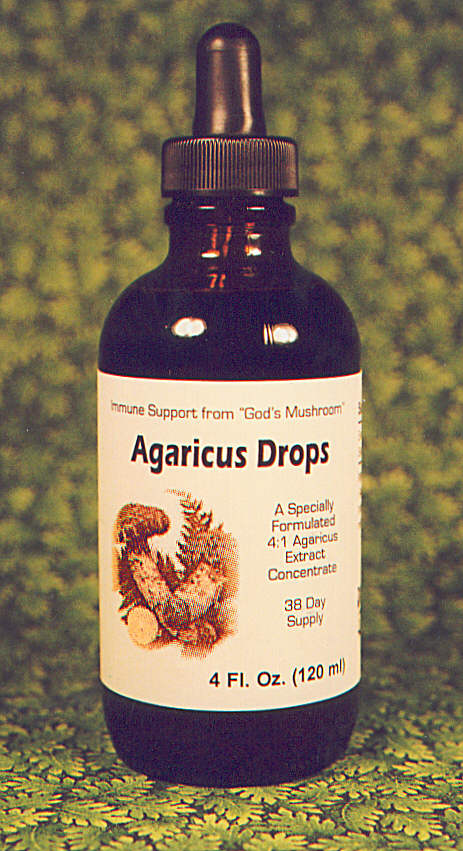
A Word About 'Agaricus Drops'
"Agaricus Drops" are a growing
phenomenon in Brazil. The highest, most concentrated form of Agaricus
extract sold commercially, this product is to Brazil what
Gotas Drops are to Uruguay.
Note that the packaging defines a dosage as 40 drops
(about one half teaspoon, or 2.5 ml.), which you take
twice a daily: before breakfast, and then at night before
retiring.
As to taste: you're going to have to chase this
one with your favorite juice. It isn't bitter or
sour, but the heavy "mushroom taste" is not a culinary
delight. This product obviously comes with a dropper
(click on photo
at left to enlarge), but you may find pouring the contents
carefully into a one-half teaspoon to be easier. Because
of viscosity, it doesn't flow through the dropper
as easy as, say, Cansema Tonic III,
or Heart Drops. Lastly,
follow labels instructions (shake before use,
refrigerate after opening, etc.)
Ingredients: Agaricus liquid extract 4:1;
1% sodium proprionate (a naturally occurring polyunsatured fat)used
to preserve product. |
Polysaccharides: ABM contains polysaccarides, both Beta(1-3)D-glucan & Beta(1-6)D-glucan protein compounds, ribonucleic acid protein compounds, acid heteroglucan, xyloglucan, lectin, etc.
Steroids: ABM contains natural steroids.
Dietary fiber: ABM contains large amounts of non digestive dietary fibers.
Fatty acids: ABM contains unsaturated fatty acid, such as linolin.
Vitamins: ABM contains vitamins B1 and B2 but also contains large amounts of ergosterol, which would be converted to vitamin D2 when it is dried in the sun or heated in a mechanical drying process.
[Top of Page]
Agaricus (ABM): General Info
This section written by Osmar Borzacchini and found
in several places on the net -- provided for background reading only
This section written by Osmar Borzacchini and found
in several places on the net -- provided for background reading only
ABM originates from Piedade, located in
the suburbs of Sao Paulo, Brazil. The climatic conditions in Piedade include
temperatures that soar to 35-38 degrees C. during the day and dip to between
20-25 C. at night, with the humidity that averages 80%. The place also experiences
regular squall toward evening. ABM thrives only under these conditions,
suggesting that its survival is significantly affected by these climatic conditions.Around the same time, ABM was introduced
to Japan. Dr. Shoji Shibata, who at the time was a professor in the harmacological
Department of Tokyo University, and Dr. Tetuo Ikegawa of the National Cancer
Center, jointly researched the pharmacological effects of 4 Agaricus. The research
results were released at the general convention of the Japan Pharmacological
Association and the Japan Cancer Association. The experience with mice verified
that the polysaccharide beta-D-glucan contained in 4 Agaricus significantly
activated the immune system.The results of the experiments suggest
that it also activates metabolism by revitalizing normal biological tissue.
Digestive enzymes such as amylase trypsin martase and the protease contained
in fungus also enhances digestion. Furthermore, tyrosinase, an enzyme which
oxidizes tyrosine and produces melanin, has a hypotensive effect.Living organisms are equipped with
immunity system which expels pathogens, toxic chemicals and tumorous cells
generated through mutation. When tumorous cells attach to form a simple protein
lump, it is Decomposed by microorganisms such as bacteria. Thanks to this function,
which is called immunity, bodies can maintain their health by fighting off harmful
microorganisms, stopping them from entering tissue or discharging them from tissue.The human immune system is comprised of more
than 130 subsets of white blood cells. About 15% of them are called Natural Killer
(NK) cells, These provide the first line of defense for dealing with any form
of invasion to the body. Each cell contains several small granules which act as
�ammunition.� When an NI cell recognizes a cancer cell, for instance, it attaches
itself to the cells outer membrane and inject these granules directly into the
interior of the cell.More specifically, natural killer cells or
NK cells play a critical role neutralizing outside organisms such as viruses and
bacteria that enter the body. Through a process called phagocytosis, the NK
cells �kiss� and engulf foreign agents and release toxic chemicals that destroy them.In cancer patients, the NK cells and cancer
cells constantly baffle one another. The NK cells attempt to destroy cancer cells
while at the same time cancer cells try to neutralize NK cells before they can
harm them. If the NK cells are weak or if there are not enough NK cells in the body,
the cancer spreads throughout the body resulting in death. Several factors contribute to
this weakening of the immune system: most notably stress, age, pollution, and smoking.When their immune systems work properly,
humans remain healthy. However, the immune systems in many people are weakened by
stress, poor eating habits and pollution, such as air pollution. These people can
suffer from a number of diseases.It is widely believed that cancer is caused by
a decline in the immune system caused by aging and other factors. It is also known
that atopic dermatitis asthma, pollinosis and rheumatism result from an excessive
immuno reaction. The AIDS virus destroys immune cells and triggers diseases. ABM, which is enjoying growing attention,
contains a large amount of polysaccharide, which is believed to enhance immunity.
Of all fungi, ABM Mushroom is particularly rich in polysaccharide.
[Top of Page]
The story of the life-enhancing ABM by Osmar Borzacchini
The ABM mushroom was discovered by Takatoshi
Furumoto in the district of Piedade near S�o Paulo in Brazil. The scientist discovered
that very few people suffered from geriatric illnesses in this community...Furumoto attributed the
healthy state of the people of Piedade to their frequently eating the
ABM mushroom. In order to examine the mushroom species,
samples were sent to the University of Buenos Aires and the University
of the Province of Mie in Japan. Finally, Dr. Shobo Shibata, who was then working
at the Department of Pharmacology as a professor, and Dr. Tetsuo Ikegawa of Japan's
National Cancer Research Centre managed to detect the pharmacological action
of ABM. That was about 30 years ago. Their research findings were published on
the occasion of the General Assembly of the Japanese Pharmacology Association and
the Japanese Cancer Research Society.ABM works like an "abridged version of the
life cycle". Setting out from the assumption that, in nature, plants behave
like producers and animals like consumers, scientists found that, in the case
of this mushroom, it turns the animal and plant remains into the basic substances
from which it makes new organic matter.Currently, mushrooms like ABM are a focal
point of attention because they are regarded as the new health boosters. Oriental
medicine has used various species of mushroom for over a thousand years. Chinese
medicine, which has now adopted some western methods of treatment, has developed
processes for extracting the active ingredients from the mushroom. These substances
are used as immunological activators, since the polysacharide �-glucan that is
contained in ABM enhances the immune system. [Top of Page]
Characteristics of ABM
The ABM mushroom grows in temperate
regions with ambient temperatures ranging from 23� to 28�C. On account of the
species having been discovered in the Piedade region, it is now referred to
world-wide as the "Piedade mushroom". In some regions it also goes by the
term "Royal Agaricus", while in Japan it is called "himmematsutake".Depending on where they are grown,
the ABM mushrooms attain a height of ten to 15 centimetres. Unlike other
species, this mushroom does not thrive in the shade of trees but in
open spaces. Its cultures can be found in pastures, by the roadside and
in open fields, especially where mules are in use. Since the ABM only grows in very
special conditions, attempts to achieve constant yields proved unsuccessful
until the early 1990s. For years, breeding ABM in artificial conditions
proved difficult, even with considerable Japanese support. It was not
possible to achieve a stable yield for marketing purposes.
[Top of Page]
Immunological Significance of ABM
Living organisms have an immune
system whose function is to eliminate pathogens, chemical toxic substances
and mutation-induced cell proliferation. Cell proliferation causes the
formation of a layer containing proteins that is decomposed by micro-organisms,
e.g. bacteria. It is thanks to this function, which we know as immunity,
that the body stays healthy. It combats dangerous organisms by preventing
them from penetrating the tissue, and therefore the body as a whole.
Attention is focusing more and
more on ABM. The mushroom contains large quantities of polysaccharides,
which have been attributed an immunity enhancing effect. In addition,
it reduces hyper-reaction of the immune system and thus contributes to
establishing an equilibrium in the system as a whole.Residue of pressed sugar cane is
used for breeding compost used in breeding Agaricus bisporus, the garden
champignon, is also ideally suited to breeding ABM. In Brazil, raw material
such as horse dung and the residue of pressed sugar cane is used normally
for this purpose. However, great care has to be taken that the compost
material is not infested with fungi, insects, mites, and other undesirable
intruders during the composting process. Pasteurisation is achieved
through heating the compost material to temperatures of 600 to 650 Celsius
in a chamber or a plastic tunnel with steam coming from a boiler. Once it has
been pasteurised, the compost material is filled into plastic sacks with
a capacity of four to five kilograms and an opening of 50 to 60 centimetres.Immediately afterwards, the ABM hyphae
are injected. Following inoculation, the plastic sacks are closed simply by
folding the sack opening in order to prevent contamination.Then, together with the fully developed
mycelia, the compost material is brought to the final location, which may
be greenhouses, sheds or open land. To grow the mushrooms in greenhouses or
sheds, the inoculated compost material that already contains mushrooms is taken
out of the plastic sacks and distributed on shelves in framed beds set up
inside the structure. These beds have to be covered with treated earth and must be
constantly kept moist. If the mushrooms are to be bred in the open, a gentle
slope that has been weeded is preferable. The compost material should be put into
40 cm-long, ten cm-wide furrows and covered with a 2-3 cm-thick layer of treated
soil. It must be constantly kept moist. The ABM mushroom requires a constantly
moist layer of soil, for it is only in these conditions that fruit formation will
occur. Using a spraying device with a large opening is recommendable
for watering in sheds or greenhouses. Out in the open, a watering can may be used.
[Top of Page]
Harvesting ABM
The mushrooms are best harvested when the
cap, or pileus, is still covered by the membrane but is already slightly
opened. The mushroom is held at the head and turned out of the soil at the
roots while a slight downward pressure is applied. Immediately after harvesting
and cleaning, the mushrooms are cut down the middle for drying and laid on bamboo
or taquara sieves. Drying can be carried out in the open or in greenhouses,
but should progress slowly. A temperature of 400 to 420 Celsius is required.
The dried mushrooms are packaged in plastic bags with a net weight of one
kilogram or less. These are distributed in response to individual orders from
direct customers or exporters for Japan or the USA. On the Brazilian market,
the prices fluctuate considerably depending on the quality of the product and
the producer. In Brazil, the mushroom is sold at kilo prices of 250 Cruzeiro
Real ([price omitted]). Elsewhere a kilogram costs [price omitted]. [Top of Page]
Osmar Borzacchini is agricultural director of Piedade District, S�o Paulo, Brazil.
AGARICUS RESEARCH - Item #1
TITLE: Anti-tumor Activity and Some Properties of Water-insoluble Hetero-glycans from "Himematsutake," the Fruiting Body of Agaricus blazei Murill.
AUTHORS: Mizuno T, Inagaki R, Kanao T, Hagiwara T, Nakamura T, Ito H, Shimura K, Sumiya T, Asakura
JOURNAL: Agricultural and Biological Chemistry; 54(11):2889-2896 1990 ADDRESS: Faculty of Agriculture, Shizuoku Univ., Ohya, Shizuoku 422, Japan ABSTRACT: After extraction of a hot-water-soluble polysaccharide (FI) from the fruiting bodies of Himematsutake (Agaricus blazei Murill), water-insoluble polysaccharides were obtained by successive extraction with 1% ammonium oxalate solution (FII), 5% sodium hydroxide solution (FIII and FIV), 20% sodium hydroxide solution (FV), and 5% lithium chloride-dimethylacetamide solution (FVI) in that order. These water-insoluble fractions were futher fractionated by ethanol precipitation, gel-filtration, etc. Polysaccharides, polysaccharide-protein complexes, and chitin substances thus obtained were assayed for their anti-tumor activities using the Sarcome 180/mice i.p. o.p. method.
The heteroglycan-protein complexes, FII-a,-b,-c, obtained from FII had weak antitumor activities. A remarkable antitumor activity was found in a lycoprotein, FIII-2-b, fractionated and purified from FIII. The polysaccharide portion of this polysaccharide-protein complex (polysaccharide, 50.2% and protein, 43.3% each on a weight basis) consisted of (1--6)-beta-D-glucan, and its protein portion was rich in Asx, Glx, Ala, Leu, and Pro.
A high antitumor activity was found in a xyloglucan-protein complex, FIV-2-b, fractionated and purified from FIV. Antitumor activity was found also in a glucoxylan, FV-2-a, obtained from FV. No significant antitumor activity was found in a chitin substance, FVI.
[Top of Page]
AGARICUS RESEARCH - Item #2
TITLE: Antitumor Activity and Some Properties of Water-soluble Polysaccharides from "Himematsutake," the Fruiting Body of Agaricus blazei Murill.
AUTHORS: Mizuno T, Hagiwara T, Nakamura T, Ito H, Shimura K, Sumiya T, Asakura A
JOURNAL: Agricultural and Biological Chemistry; 54(11):2897-2906 1990
ADDRESS: Faculty of Agriculture, Shizuoku Univ., Ohya, Shizuoku 422, Japan
ABSTRACT: Polysaccharides extracted from Himematsutake, the fruiting body of Agaricus blazei Murill with hot water were fractionated and purified by ethanol precipitation, ion-exchange chromatography, gel-filtration, affinity chromatography, etc. A total of 17 polysaccharide samples thus obtained were given an antitumor activity test (Sarcoma 180/mice i.p. p.o. method) and traces of their activities through the fractionation and purification processes were found. FI0-a-beta, FA-1-a-alpha, FA-1-a-beta, and FA-2-b-beta, were obtained as water soluble polysaccharides fractions having great antitumor activities. Analyses of physico-chemical properties and IR- and NMR-spectra of the these active fractions showed that their main components were: FI0-a-beta, (1--6)-; (1--3)-beta-D-glucan; FA-1-a-alpha, acidic (1--6)-; (1--4)-alpha-D-glucan; FA-1-a-beta, acidic (1--6)-; (1--3)-alpha-D-glucan; and FA-2-b-beta, acidic RNA-protein complex. [Top of Page]
AGARICUS RESEARCH - Item #3
TITLE: Selective Tumoricidal Effect of Soluble Proteoglucan Extracted from the Basidiomycete, Agaricus blazei Murill, Mediated Via Natural Killer Cell Activation and Apoptosis.
AUTHORS: Fujimiya Y, Suzuki Y, Oshiman K, Kobori H, Moriguchi K, Nakashima H, Matumoto Y, Takahara S, Ebina T, Katakura R
JOURNAL: Cancer Immunol Immunother; 46(3):147-59 1998
ADDRESS: Division of Immunology, Miyagi Cancer Center Research Institute, Natori, Japan.
ABSTRACT: We have isolated a novel type of natural tumoricidal product from the basidiomycete strain, Agaricus blazei Murill. Using the double-grafted tumor system in Balb/c mice, treatment of the primary tumor with an acid-treated fraction (ATF) obtained from the fruit bodies resulted in infiltration of the distant tumor by natural killer (NK) cells with marked tumoricidal activity. As shown by electrophoresis and DNA fragmentation assay, the ATF also directly inhibited tumor cell growth in vitro by inducing apoptotic processing; this apoptotic effect was also demonstrated by increased expression of the Apo2.7 antigen on the mitochondrial membranes of tumor cells, as shown by flow-cytometric analysis.The ATF had no effect on normal mouse splenic or interleukin-2-treated splenic mononuclear cells, indicating that it is selectively cytotoxic for the tumor cells. Cell-cycle analysis demonstrated that ATF induced the loss of S phase in MethA tumor cells, but did not affect normal splenic mononuclear cells, which were mainly in the G0G1 phase. Various chromatofocussing purification steps and NMR analysis showed the tumoricidal activity to be chiefly present in fractions containing (1-->4)-alpha-D-glucan and (1-->6)-beta-D-glucan, present in a ratio of approximately 1:2 in the ATF (molecular mass 170 kDa), while the final purified fraction, HM3-G (molecular mass 380 kDa), with the highest tumoricidal activity, consisted of more than 90% glucose, the main component being (1-->4)-alpha-D-glucan with (1-->6)-beta branching, in the ratio of approximately 4:1.
[Top of Page]