Artemisinin:
Background

 Many marvels of modern science are
discovered by accident (i.e. Alexander Fleming and the discovery of
penicillin). It is in keeping with the more unusual, unplanned
paths to discovery (or in this case rediscovery)
that "artemisinin" attracted renewed attention. The compound we now know we
"artemisinin" was first extracted by the Chinese thousands of years
ago. It's traditional use has included both vermifugal (there is
some wormwood in our Old Amish Dewormer)
and as a treatment for malaria. The latter treatment was lost over
time, but then rediscovered in an archaelogical dig in the 1970's -
at which time, ancient medical remedies were found, translated,
and published. Today this wormwood extract
is used in Asia and Africa in antimalarial medicine. Its
mechanism is well-known: artemisinin reacts with a high concentration
of iron (ferrous compounds) - which is exactly what is found in
the malaria parasite. When artemisinin comes into contact with
high iron concentrations, a chemical reaction is produced which
creates free radicals that attack cell membranes, breaking them
apart and killing the single-cell parasite. Artemisinin has
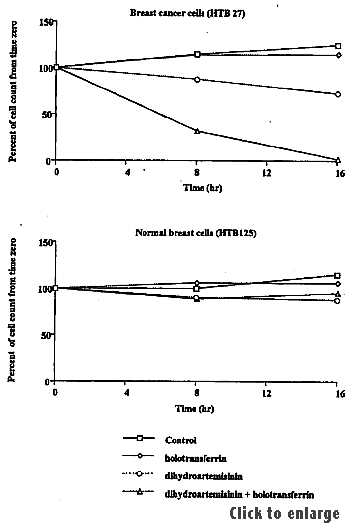
also been the subject of in vitro laboratory research at the
University of Washington. (See the related links at right.)
|
To U.S. Users: This product
has not been evaluated by the U.S. Food & Drug Administration, and
is not intended to diagnose, treat, cure, or prevent any disease. |

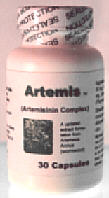
Artemis (30 Caps)
| Availability
30 Day Supply - Each cap contains Artesunate 50 mg.,
Artemether 40 mg., Artemisinin 50 mg., (Pharmaceutical grade).
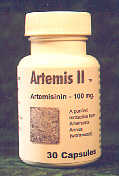
Artemis II (30 Caps) | Availability
30 Day Supply - Each cap contains Artemisinin 100 mg. (Pharmaceutical grade).
30 Day Supply - Each cap contains Artesunate 50 mg.,
Artemether 40 mg., Artemisinin 50 mg., (Pharmaceutical grade).
Artemis II (30 Caps) | Availability
30 Day Supply - Each cap contains Artemisinin 100 mg. (Pharmaceutical grade).
How Ancient Wormwood Extracts Were Rediscovered
[ U. of Wash. study ]
[ U. of Wash. study ]
 ew nutraceuticals
have come to the forefront under
such unusual circumstances. Artemis, our brand for a potent
combination of
wormwood
derivatives, contains pharmaceutical grade
artensunate,
artemeter, and
artemisinin
(see botanical distribution, or excellent dissertation on its
pharmacokinetics,
which includes an elaboration on its historical usage). Individually,
or in combination, these compounds
are used in Asia as antimalarial drugs
(see origin as
antimalarial drug; also,
Cochrane
review).
[We thought "Artemis" was an appropriate name, because
not only was it an alliteral truncation of "artemisinin," but it is
also the name for the Greek goddess of the hunt - who also
defends women in labor, children, and small animals.]
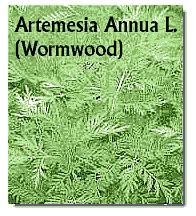
 All three compounds are derived
from the herb Artemisia annua L., locally known in Southeast Asia
as "qing hao," which is a member of the "Asteraccae" family.
(Common names include "sweet wormwood" or "annual wormwood".) The earliest record of
wormwood's medicinal use was found in a recipe inside
a tomb during an archeological dig in the 1970's. This formula
dates back to 168 B.C. (Qinghaosu Antimalaria Coordinating Research Group,
1979; Klayman, 1985). Chinese chemists isolated the primary active
ingredient from the leafy portion of A. annua L. in 1972 and called
the crystalline compound, "qinghaosu" - or "artemisinin" in the West
(Klayman, 1985).
 The most active research
in the field of wormwood derivatives is currently taking
place in China. (One example is the
Artemisinin Research & Development Center in Beijing.) Our own sources for Artemis
come from China.
 Toxicological Considerations:
Although the dosage of Artemisinin compounds in Artemis is too
low, at the recommended dosage, to pose toxicological risk, larger
dosages should not be contemplated without the oversight of a physician
who is well acquainted with the properties of Artemisinin and its
compounds.There has been some, expressed concern centering on
possible
neurotoxicity - (since a metabolite of artemisinin, dihydroartemisinin, is
claimed to have shown neurotoxicity
in various
in vitro and in vivo assays).
None of these concerns have manifested as actual
neurotoxicity cases in the field -- and there may well be political
factors that have initiated these concerns. Nonetheless, care should
be exerted to provide maximum safety for the patient.Other properties of this products
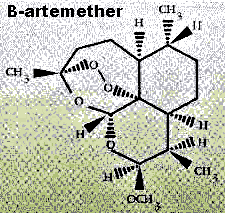
key components: �-Artemether - a white anhydrous crystalline powder,
is a derivative of Artemisinin and is more
chemically active than its parent (WHO, 1986). Technically, it's
chemical name is: [3R-(3a, 5aB, 6B, 8aB, 9a,10a, 12B, -12aR*)]-Decahydro-10-methoxy-3,
6, 9-trimethyl-3, 12-epoxy-12H-pyrano[4,3-jl-1,2-benzodioxepin, and
in most phamacopaeias in which it is now listed, its pharmacological
class is "antimalarial." (It's molecular formula is C16-H26-O5,
and it has a molecular weight of 298.38.) Artemisinin is a sesquiterpene lactone
that bears a peroxide group and unlike most other antimalarials, lacks a
nitrogen-containing heterocyclic ring system. It is poorly soluble in water
and decomposes in other protic solvents, probably by opening of the lactone
ring. It is soluble in most aprotic solvents, is unaffected by them up to
150°C and is poorly soluble in oil. It shows a remarkable thermal
stability. The peroxide moiety of artemisinin appears to be indispensable
for chemotherapeutic activity. When artemisinin is treated with
borohydride to give dihydroartemisinin, a lactol is formed in which the
integrity of the peroxide group is retained and the schizonticidal
activity is enhanced tenfold. Although it is desirable that a single epimer
is used, there seems to be no evidence that the a- and �-epimers differ
greatly in antimalarial activity.
Ingredients: Artesunate 50 mg., Artemether 40 mg., Artemisinin 50 mg., (Pharmaceutical grade). Directions: Take one capsule per daily or as directed by your physician.
Related Links:
Ancient Chinese Folk Remedy May Hold Key to Non-Toxic Cancer Treatment (Newswise)
Chinese Herb Triumphs Over Cancer (altmedangel)
Chinese Remedy May Fight Cancer (BBC News)
Malaria Drug May Hold Key to Nontoxic Treatment (Breast Cancer Fund Report)
Wormwood is the basis for a cancer fighting pill (ENN)
Info on artemisinin
Structural Modification of Active Principles from Chinese Medicine
--- (Natural Products Laboratories, School of Pharmacy, Univ. of North Carolina)