
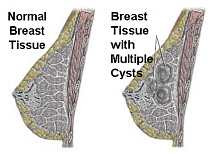
A cyst is a closed sac or poupch, with a definite wall, that contains fluid, semifluid,
or solid material. It is an abnormal structure resulting from developmental anomalies,
obstruction of ducts, or parasitic infection. Fibrocyst is a fibrous tumor that has undergone
cystic degeneration or has accumulated fluid in the interspaces. Lumps in the breast that are
benign but painful are called chronic cystic mastitis, or fibrocystic breast disease.
Affecting one in five women, mainly in the 30-50 age group, this disease generally subsides
after menopause. Hormonal changes during menstruation and menopause cause breast tissue to
shrink and swell at various times during a cycle. Normally, the lymphatic system collects
fluids and transports it out of the breast. However, if more fluid accumulates than the
lymphatic system can handle, this fluid will fill in spaces in the breast tissue and form
cysts.
Helpful Links:
Fibrocystic Breast Disease

ysts in the breast are not
in themselves considered dangerous, but it is harder to detect possible cancerous lumps
if cysts are present. They can be alone or in clusters, the latter more common in fibrocystic
breast disease. About 30% of American women, mostly in their 30's and 40's, are affected.
During menstruation and menopause, repeated cycles of hormonal stimulation
may cause the cysts to become chronically inflamed and surrounded by fibrous tissue. This
tissue can harden and thicken the cysts, thus making it more difficult for the pockets of
fluid to be reabsorbed by the body. Changing the diet has a great impact on the frequency,
number, and pain of cysts. A diet low in fat and high in fiber is helpful, as is a
reduction in the amount of caffeine consumed. Additionally, there are several herbal
alternatives to preventing and treating fibrocystic breast disease.
Black Cohosh, with many
qualities similar to that of estrogen, has been used for decades in the treatment of
menopausal disorders. It seems to reduce the fluctuation of estrogen in the body, thereby
reducing its influence on the breast.
Saw Palmetto, as an
anti-inflammatory, helps to reduce inflammation of the breast. Other herbs that effectively
reduce pain and inflammation of breast cysts caused by hormonal changes are
Red Clover,
Goldenseal, and
Pau d'Arco.
 These
products are available from our
Virtual Store.
Our liberal
Money Back Guarantee applies.
These
products are available from our
Virtual Store.
Our liberal
Money Back Guarantee applies.
These
products are available from our
Virtual Store.
Our liberal
Money Back Guarantee applies.
Note:
This information is provided for educational purposes only
and is not intended to replace the use of a qualified
health care professional. We strongly recommend the use
of a physician for the diagnostic phase of any treatment.
With an accurate diagnosis in hand, we believe the consumer,
at that point, has a basic, unalienable right to seek out
factual information on all therapeutic approaches, both
orthodox and alternative, and choose those approach(es)
that are right for them. Nonetheless, a "good doctor"
should be considered a requisite starting point.To U.S. Users:
None of the products mentioned on this page have been
evaluated by the U.S. Food & Drug Administration;
therefore, they are not intended to diagnose, treat,
cure, or prevent any disease.