
The gallbladder is a pear-shaped sac on the underside of the right lobe of the liver that
stores bile received from the liver. In the gallbladder, bile is concentrated by removing
water, then discharged through the cystic duct. When bile contains more cholesterol than
can be concentrated in the gallbladder, gallstones can form. The incidence of
gallstones is twice as much in women as in men. Obesity increases the risk of developing
gallstones. Symptoms may remain dormant until the gallbladder becomes inflamed and distended
or unless the stone enters and is unable to pas through teh biliary ducts. The pain, which
radiates to the back and right shoulder, usually occurs several hours after eating when the
stomach is empty. Flatulence is a common sympton.
Helpful Links:
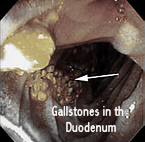
Gallstones

hen bile in the gallbladder
becomes oversaturated with cholesterol (or, rarely, calcium), the extra compounds may
crystallize into gallstones. These may be as small as a sweet pea to as large as an egg.
Probably half the people who have gallstones experience no symptoms. The problem occurs
when during expulsion of a gallstone, it gets stuck in the bile duct. Symptoms then include
severe pain in the upper right side of the abdomen that may radiate into the back and right
shoulder, nausea, vomiting, bloating, or belching.
 Approximately 20 million Americans have
gallstones each year. Risk factors include diets high in fat, protein or sugar; high
cholesterol; some food allergies; and obesity. The current favored treatment for gallstones
is surgical removal of the gallbladder. Lithotripsy, another type of treatment, uses sonic
shockwaves to break up the stones, while a third treatment calls for a long tube to be
inserted into the gallbladder, and a strong solution administered which dissolves the stones.
Approximately 20 million Americans have
gallstones each year. Risk factors include diets high in fat, protein or sugar; high
cholesterol; some food allergies; and obesity. The current favored treatment for gallstones
is surgical removal of the gallbladder. Lithotripsy, another type of treatment, uses sonic
shockwaves to break up the stones, while a third treatment calls for a long tube to be
inserted into the gallbladder, and a strong solution administered which dissolves the stones.
If you prefer not to have surgery to remove
gallstones, there are some herbal remedies worth a try.
Dandelion root has for
generations been used to treat both liver and gallbladder obstructions. It is also helpful
in promoting bile production, which is a good thing--more bile means less chance of it being
oversaturated by cholesterol.
Milk thistle is an
excellent herb to reduce the concentration of cholesterol already in the bile. Herbs that
are known to be helpful with the digestive system are
Cramp Bark,
Fennel, and
Ginger. These herbs tend to
increase digestive enzymes which aid in the digestion of food.
These
products are available from our
Virtual Store.
Our liberal
Money Back Guarantee applies.
Approximately 20 million Americans have
gallstones each year. Risk factors include diets high in fat, protein or sugar; high
cholesterol; some food allergies; and obesity. The current favored treatment for gallstones
is surgical removal of the gallbladder. Lithotripsy, another type of treatment, uses sonic
shockwaves to break up the stones, while a third treatment calls for a long tube to be
inserted into the gallbladder, and a strong solution administered which dissolves the stones.
If you prefer not to have surgery to remove
gallstones, there are some herbal remedies worth a try.
Dandelion root has for
generations been used to treat both liver and gallbladder obstructions. It is also helpful
in promoting bile production, which is a good thing--more bile means less chance of it being
oversaturated by cholesterol.
Milk thistle is an
excellent herb to reduce the concentration of cholesterol already in the bile. Herbs that
are known to be helpful with the digestive system are
Cramp Bark,
Fennel, and
Ginger. These herbs tend to
increase digestive enzymes which aid in the digestion of food.
These
products are available from our
Virtual Store.
Our liberal
Money Back Guarantee applies.
Note:
This information is provided for educational purposes only
and is not intended to replace the use of a qualified
health care professional. We strongly recommend the use
of a physician for the diagnostic phase of any treatment.
With an accurate diagnosis in hand, we believe the consumer,
at that point, has a basic, unalienable right to seek out
factual information on all therapeutic approaches, both
orthodox and alternative, and choose those approach(es)
that are right for them. Nonetheless, a "good doctor"
should be considered a requisite starting point.To U.S. Users:
None of the products mentioned on this page have been
evaluated by the U.S. Food & Drug Administration;
therefore, they are not intended to diagnose, treat,
cure, or prevent any disease.