
Common acne (or "acne vulgaris") is almost a rite of passage among many Western youths going through puberty. Although the cause is unknown, it is important not to confuse this condition with other forms of acne that have known causes that can be quite easily treated: summer and "tropical" acne, caused by a hot, humid climate; cystic acne, which can be treated with isotretinoin, a Vitamin A derivative; etc.
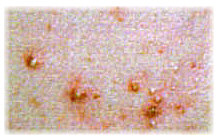
 Common acne, which
usually appears on the face, neck, and shoulders, is
accompanied by papules (or pimples) or lesions (called
"comedos") with either black centers (pustules) or
nodules created by overgrowth of connective tissue.
Some lesions are deep-seated and can cause scaring. Predisposing factors
known to influence acne include hereditary tendencies and disturbances
in the androgen-estrogen balance. External factors can include
exposure to halogens, vitamin deficiencies, exposure to certain
chemicals such as tar and chlorinated hydrocarbons, etc.
Acne normally begins at
puberty, when the body increases secretion of androgen in both
males and females, thereby increasing the size and activity of
the pilosebaceous glands. In females the lesions may worsen
just before menstruation. Bacteria are known to worsen existing
acne, which explains the benefit some sufferers receive from
antibiotic therapy.
 Acne
 cne is so common, that most indigenous cultures
have a specific ethnobotanical tradition for it.
The following products have a history of
traditional use in skin care:
(1) Cansema Capsules;
(2) Acne, a traditional Brazilian
formulation in our Amazon group; (3)
H3O Hydronium solution (see our
lab notes); and (4)
Neem Tree Oil,
which is widely used in traditional skin care
on the Indian subcontinent. On this fourth
item: the neem creme,
lotion, soap and internal capsules ("vegecaps") all
have traditional uses. (See our list of
traditional skin uses of neem on the third page
of our Neem Common Use Table.) We recommend that you
become familiar with neem before using it. Recommending readings
include: properties and general
uses of Neem; traditional uses of
neem; neem testimonials which
includes a recent comment from a 13 year old boy;
Neem: Ancient Herb from India,
which includes quotations from scientific journals on
neem; and
Neem: Gift of Nature.


Acne: Input from the Allopathic Community
 Acne Classifications
Note: This information is provided for educational purposes only and is not intended to replace the use of a qualified health care professional. We strongly recommend the use of a physician for the diagnostic phase of any treatment. With an accurate diagnosis in hand, we believe the consumer, at that point, has a basic, unalienable right to seek out factual information on all therapeutic approaches, both orthodox and alternative, and choose those approach(es) that are right for them. Nonetheless, a "good doctor" should be considered a requisite starting point.