
Cansema®: Minimizing
Pain, Discomfort and Itch
The Latest in Pain Management
Products & Technologies
Stronger Pain Management Options for 2021

 he pain management options we provide in the
Simple Techniques section below should be reviewed first. Many of these are easy
to implement and cost little to nothing. On the other hand, we encounter pain management cases where
relief is sought, and something stronger is required than "simple techniques," and yet the problem is
not so severe that serious pharmaceutical analgesics are required. Please note that some of the products
we mention are available on our stores, and others are situations where we simply make referrals to
other trusted vendors, since we are not allowed to sell these products on our websites. Any questions
about these matters can be addressed to us at: support@herbhealers.com.
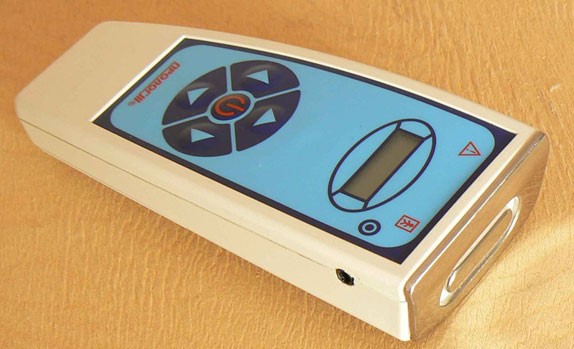
- Russian Scenar Tecnology & Devices --
We began carrying scenar devices from Russia in 2003. For many
pain management issues, it's an amazing technology, and it is only because of the politics that this device is so widely used in
Russia and other countries in the former Soviet Union, yet few in the West even know about it. I was initially inspired to
begin my investigations of scenar technology, because both my father and I were suffering from arthritis in the knees.
In my own case, at the relatively young age of 47, I was having trouble even getting out of bed in the morning. The
pain was that severe. With just a few treatments -- in both my father's case and mine -- the arthritis was gone.
I'm not just talking about the pain. In both of our cases, the arthritis was gone. My arthritis has never returned.
Back in 2003, I used to charge $1,595 for the Prologue 2D -- something
I regarded as a little miracle worker.
Today, I work with a company in Minsk (Belarus), which manufacturers an updated version of the Prologue 2D,
which they call the Prologue 02-M. We retail the device on our stores for
$490, and that price includes FedEx delivery to your doorstep. Before considering a purchase, I encourage you to
read the operating manual, which comes with
a separate text of appendices
that will be of particular importance to practitioners.
Buyback Policy: If you purchase the Prologue 02-M, and you
are able to resolve your health issues such that you no longer need or want the device, we will purchase the unit back from
you less a $125 restocking charge, provided the purchase date is not older than 90 days old.
- Specialty Analgesic Herbal Products -- We work as consultants for a variety of herbal suppliers,
and have access to a wide range of hard-to-find, hard-to-get remedies. The problem is that the legal and regulatory milieu
has become enormously complicated: what is legal in one jurisdiction may not be legal in another. Certain items can get
you blacklisted. You don't have to sell them. You only have to mention them in passing to have problems.
For this reason, if you are looking for natural analgesic above and beyond the items
we make available on our site, just write to us at support@herbhealers.com to check availability.

ecently we received an email from one of the members of a feline
cancer group that information on "pain management issues" were
not clearly made available. This -- despite the fact that there
are not less than four pain-related questions in the Cansema®
FAQ section, and it is prominently mentioned in both
" Range of Physiological Response" and
Cansema's User Instructions.
 There is, however, another
reason this area is having to be revisited. Originally, Cansema®
Black Topical Salve was used to remove skin cancers. That was
the extent of its use. Today it is used by both end users and
practitioners alike for any cancers that are in close proximity
to the skin - on both humans and animals.
The purpose of the rest of this page is to more conveniently place
the most salient points about potential "pain management"
issues on one page, linked from the main Cansema page, so
that it is more likely to be read.
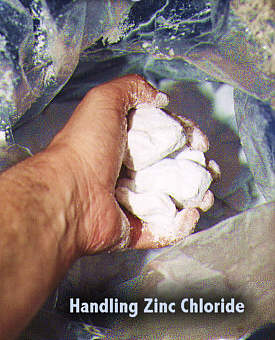
As stated elsewhere on this site,
the range of potential pain response to the application of
Cansema is vast -- most people who apply Cansema
to a small area of healthy tissue will feel little more than
mild irritation. To prove our point, we even reproduced a picture
in our FAQ section (see right) showing
one of our production workers handling pure, full strength zinc chloride,
the most caustic compound in Cansema with his bare hand --
(don't try this at home).
At the other extreme are
specific cancers to which Cansema can be applied where
a pain response is produced such that we do NOT advise
users to attempt it without competent medical supervision - (which,
admittedly, cannot be found in this area for many, particularly
in the U.S. or countries of the British Commonwealth,
excluding the Bahamas). This would include most cases of breast
cancers and larger growths in excess of two inches (five centimeters)
in diameter.
We strongly advise users
to read the User Instructions thoroughly
before attempting the use of Cansema®. Below we provide various
strategies for minimizing the pain response one can experience
in conjunction with the use of Cansema®. Please note that
in serious cases, you may elect to use one or more of these
techniques concurrently.
Analgesic Topicals
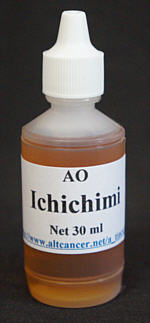
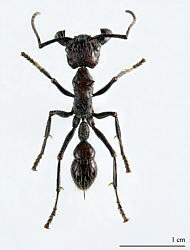
- "Ant Tinctures" -- We carry three different
"ant tinctures," which when topically applied,
greatly reduce any pain response. Izulant is the strongest of
the three, but AO Ichichimi will numb the area entirely.
You can apply with a cotton pad, or you can do what the indigenous
of the deep Amazon do: put down anywhere from two to ten drops
(depending on the size of the painful area) and rub it into the skin.
Please read the product page before purchasing
this item.
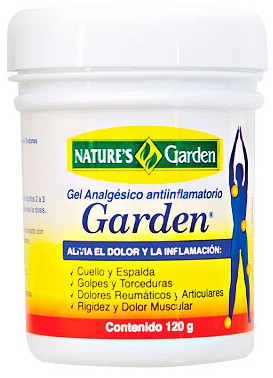
- Garden® -- Garden® is a
topical analgesic and anti-inflammatory gel. Although it is most commonly used for neck, back, arthritis, and joint pain,
it can also be used to minimize pain created by escharotic use, although it shouldn't be applied directly to open sores.
See product page.
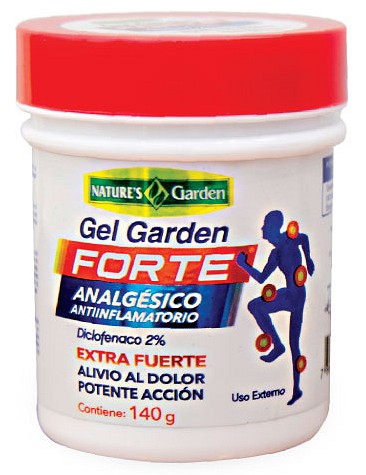
- Garden Forte® -- Garden Forte® is a topical analgesic and
anti-inflammatory, stronger than Garden® and not recommended for children under 11. Like Garden® above, it can be used
to minimize pain created by escharotic use.
Please examine the product page for more information.
- Propolis Cream -- Crema de Propóleo --
Propolis Cream is an amazing topical that is used throughout Ecuador to treat
rheumatism and arthritis, muscle pain, aches and pains in the back, neck, and feet, as well as nail fungus in the hands and feet.
It contains honey, bee pollen, propolis, and royal jelly.
Please examine the product page for more information.
- "Removing Cancer in Stages" -- All else being equal,
there is a direct correlation between the size of the cancerous
area one is addressing and the level of pain response. The more
Cansema® you apply, the more sensation you get. Knowing
this simple fact allows one to spread out sensations over
the timeline of treatment so that the user has greater control
over any pain response.
For this reason we advise
customers in our Cansema User
Instructions page that if the growth is larger than two
centimeters in size, they may elect to apply small dabs -- the
size of a waterdrop -- on the periphery.
Once the intensity of the
sensation has been gauged, the user may then proceed to apply
additional "dabs" until the entire area is covered. What this
essentially does is dilute the intensity of the response by
"extending the timeline" in removing the cancer growth.
- "Cutting Cansema®" -- This technique is behind
the creation of Cansema Salve
with Aloe Vera, but you can essentially do the same thing at
home.
Typically, this involves
taking a teaspoon (5 ml.) of Cansema® from the small (22g.) jar, or
a Tablespoon (15 ml.) from the large (102g.) jar and "mixing" it thoroughly
"50/50" with either aloe vera gel or virgin coconut oil. If a 50%
dilution is not sufficient for a particularly sensitive area, one
can dilute further. A mix of one part Cansema to two parts of
the aforementioned excipients (66% dilution) is normally sufficient
for even the most sensitive areas, topically.
As in the case of the
first technique above, what the user is doing is "extending the
timeline," but this time this extension is created not by
restricting the area of application, but by weakening the
strength of the product so that more applications will be
required to remove the entire growth being targeted.
It is difficult to
quantify these things because every case is different, but
to understand the principle have in mind that you going
to "take twice as long to complete the process, but experience
half as much pain."
. . . an oversimplification,
perhaps, but you get the point.
- "Restricted Area / Cut Cansema® -- Simply put,
this involves employing both the first and second technique above:
restricting the area of application and using a cut version
of Cansema®. Obviously, you would only need to do this with
larger cancers in sensitive areas of the body: ears, breasts,
external areas of the reproductive organs, etc.
- Ice Pack -- Sometimes the application of an ice
pack to the affected area will do the job.
- Acetic acid solution --
Many alternative practitioners use 2% acetic acid solution on
topical wounds to reduce pain. This is very easy to make and
very inexpensive. You can do it yourself just by putting about
2 Tablespoons (about 30 ml., or one fluid ounce) of
apple cider vinegar into one liter (one quart is close enough)
of distilled water. Apply liberally to the site of
pain sensation with a cotton pad or ball.
- Pain relief through eliminating subluxations -- Pain can
also result from stresses or "subluxations" created in the muscle
tissue. If your treatment is over muscle tissue and a pain has
been created that doesn't seem to be going away, we advise that
you seek out treatment from a chiropractor or osteopath. If this
is the cause of the pain, either professional can resolve the problem.
- OTC & Prescription Analgesics --
If the above techniques prove inadequate, users may
consider OTC or prescription grade analgesics.
Although our orientation as naturopaths leans strongly towards natural,
plant-derived remedies, we realize that there is a place
in the world for stronger medications. Some users find
that temporary use of an OTC painkiller can help.
You may, however, follow our instructions,
encounter a larger growth than you anticipated, and discover that
over-the-counter pain killers are just not doing the job.
[These OTC products fall broadly into three categories:
(1) salicylates (like aspirin), (2) nonsteroidal
anti-inflammatory drug (NSAID's, such as Motrin, Celebrex,
Vioxx, etc.), and (3) acetaminophen (includes Datril,
Tylenol, Panadol, and Tempra).]
The next step
up is what pharmacists call "narcotic agonist-antagonist"
drugs, most of which require a prescription in most Western
countries. The section in the Physicians' Desk Reference
(PDR) devoted to such narcotic analgesics is extensive.
Among the most commonly prescribed products in the categories are
Darvocet, Demerol, Percocet, Roxanol, and OxyContin.
Originally, the use
of narcotic analgesics to deal with pain was never suggested.
As stated earlier, Cansema's use was pretty limited to our
original stated application: small skin cancers. As its
applications have expanded (which was a natural development
born of its effectiveness), the need to broaden the view
of possible analgesic needs has grown as well.
How to view the process:
To understand why there would even be a need for analgesia
in conjunction with Cansema use to begin with, it helps
to understand the nature of the escharization process.
In a very real way, escharization involves a cooperative
effort between the escharotic preparation - a mere initiating
agent - and your body's own immune system. For all intents
and purposes, Cansema sets into motion a series of
physiological events that translate into the body
conducting its own surgical operation against the cancer
growth. Any surgical procedure, whether initiated by
the body or performed by the skilled hand of a surgeon
so trained and licensed, can involve discomfort - and if anything,
Cansema normally provides a method of removal that involves
far less invasiveness and pain than the same exercise
employing metal surgical tools. This should not be
interpreted to mean there are not situations where
medical surgery is not the best modality for the removal
of a growth - cancerous or benign. But an objective perusal
of substantial growth removals, as reported on any one of our
eight Cansema Testimonial pages,
with little or no analgesia, will convince all who do not
already have a preset disposition in the matter.
Anyone who has used escharotics extensively knows that
occasionally, significant "itch" sensations can occur. If you use any of our escharotic
salves, including Cansema or even our
Bloodroot Paste, you may notice in the course of
self-treatment that "itch" develops. The technique below tells you how to easily get rid of it.
Liberally apply
pure copaiba oil to the site of the itch --
(available on our sales sites). Then apply heat from a hair dryer at high heat and
medium fan speed over the site. The head of the hair dryer should be roughly two
to three inches over the site. (You can get some of the benefits of this technique
even without the copaiba, by the way, because the heat itself disrupts the process
that initiates the itch sensation itself.)
The trick with this technique is to concentrate
right on the itch. The itch will "light up" and be "burning" far more than any of the
tissue around it. That's when you know you "have the target." Some users prefer to
use a low setting and focus on the "itch spot" while varying the distance from the skin
to get just the right heat. High speed works, too, but it is too intense for some users.
There is an intense reaction of both pleasure and pain when you focus on the right spot.
Hit the area with the maximum amount of heat you can stand. When it gets too uncomfortable,
pull the heat away and see how it feels. The itch may fade away with several passes or if
you hit it hard enough, it has been known to disable the itch instantly. If the itch is
still not gone, hit it again until it is. Many report a technique where they "hit it hard"
and then pull away -- off and on about five times -- until "you've blasted it good."
It does take some practice and adaptation to the "heating sensation," but it does
get rid of the itch.
Remember this technique because it also works on
itch sensations produced by other causes. One user reported that it worked on a burning
rash he gets in the summer. "I blast it with high heat, and it hurts, but completely
stops the rash infection, otherwise, I have to use an antibiotic ointment."
In closing, if for any reason,
you are unsure about the use of Cansema for your particular
application, or if you are a practitioner and have more
in-depth questions - general or specific,
please email us.
 Back to Cansema Opening Page
Home Page
Order Form
Back to Cansema Opening Page
Home Page
Order Form
Created : May 29, 2002; Last updated : February 8, 2021
|
 Updated Nov, 2014; Dec, 2018; May, 2020; Feb, 2021